
What my iridology reading saw before the doctors did
In April 2016, a laparoscopy declared Paige's right ovary clear. In October, she was in urgent care with pain she thought was appendicitis. Between those two dates — an iridology reading.
Louis James Ed
3/23/20267 min read
Subscribe to Louis's newsletter
Enjoy exclusive updates available only to Louis's subscribers.
Being told you're fine when you know, with a certainty that exists somewhere beneath words, that you're not causes a certain kind of weariness. When Paige came to me, she had been carrying that tiredness for a while. The tests had already been given to her. The surgery had already been performed on her. There was nothing to worry about, according to the paperwork she had. She knew that something was wrong, but no one in the traditional medical system had been able to identify it.
I don't want to make the doctors who treated Paige look bad by telling this story. They were doing exactly what medicine is supposed to do: looking for pathology that their tools could pick up at that time. Iridology provides something else. It doesn't look for sickness. It looks for constitutional tendencies, or the patterns that show up before pathology becomes clear. It also looks for the body's own signals about where stress is building up and where intervention might stop something from getting worse.
Each person must decide for themselves if that is useful or not. What happened to Paige is just what happened. I'm not asking anyone to come to a conclusion based on it. I just want you to read it carefully because the whole story is important, and it needs more than a bullet point or a five-star review.
The month that said everything is fine
Paige had a laparoscopic procedure, which is a type of keyhole surgery, and scans in April of that year. These things are not small. You need general anesthesia for a laparoscopy. It involves a surgeon using cameras to look directly at the organs in the pelvic and abdominal areas. The scan also added pictures to the mix. Together, they give a complete and invasive look at the body. And together, they didn't find anything wrong with Paige's right ovary.
That finding was not careless or negligent. It was true to what was there in April. It couldn't explain what was happening in the months that followed, when things were getting worse but not bad enough to warrant an investigation. A cyst that is not yet a cyst does not appear on a scan. A structure that is beginning to accumulate fluid but has not yet reached clinical significance will not show in a laparoscopy. Medicine sees what is there. It is not designed to see what is becoming there.
This distinction is not a criticism of medicine. It is simply a description of what medicine is and, by extension, of the space that exists alongside it.
The reading
As usual, I looked at the entire constitutional picture when I examined Paige's iris, including the collarette, pupillary zone, peripheral ciliary zone, overall iris color, and fiber structure. I was observing the regions of the iris that displayed lacunae, color changes, stress patterns, or other indications of accumulated load on a specific body system.
There was something I could not ignore in the right iris, in the area that corresponds to the right side of the lower body, which includes the groin, the leg, and the reproductive organs. Here, I'm using deliberate language. A cyst was not visible to me. Tumors and cysts are invisible to iridology. What I observed was a pattern in the iris fibers that suggested the body was directing energy and load toward that area in a way that required attention, as well as a marking that indicated significant constitutional stress in that area.
-What the iris indicated
Significant stress marking in the area that corresponds to the right leg, groin, and right ovary in the lower body zone of the right iris. An accumulated load is suggested by the constitutional pattern. Clinical note: Regardless of the latest imaging results, this zone needs to be attended to. The iris shows where the body is exerting the most effort, but it does not confirm a diagnosis.
I want to be open about the hesitancy that occurs in circumstances such as these. Paige had previously undergone a laparoscopy. Scans had already been performed on her. Nothing had been discovered by those methods. There is a legitimate concern about what to do with information revealed by the iris that has not been discovered by recent conventional research. It runs the risk of sounding alarmist about something that medicine has already resolved if it is included in the report. Ignoring what I was seeing would be equivalent to excluding it.
I included it in the report. I noted a recurring pattern of stress showing up in the right lower part of the body around the leg, groin, or ovary. Even with the recent surgery and imaging results, I felt this area still needed to be watched. I chose my words very carefully. I wasn’t trying to overstate anything, make a diagnosis, or dismiss what had already been found. I simply wrote what I could see. At the end of the day, I believe the role of this work is to observe honestly and report it as clearly as possible and then leave it in the hands of the client and their medical team to decide what it means and what to do next.
"I thought it had to be the leg or groin — the ovary was deemed fine per my laproscopic surgery and scans in April. Well, it's not."
— Paige
The months in between
When Paige read the report, she was sceptical about the ovary finding understandably so. She had the medical paperwork that said it was fine. She told me afterwards that she assumed the marking I had described must be referring to the leg or the groin rather than the ovary, because the ovary had been looked at directly and cleared. She filed the report, noted the observation, and moved on.
Paige didn’t put her life on hold because of what I wrote. She simply kept the information in the back of her mind and carried on, aware but not overwhelmed.
And then the pain started.
It came on in that unsettling way pain sometimes does, intense, frightening, and without a clear cause. Paige said it was the worst she’d ever felt. At one point, she thought it might be appendicitis. Then she wondered if it could be a kidney stone.
Two days ago, when she messaged me, it had gotten so bad she went to urgent care in the middle of it, struggling just to stand.
The doctors at urgent care found a massive ovarian cyst on her right ovary.
The moment she wrote to me
Paige sent me a message the day after the urgent care visit. She was still processing what had happened, both the pain and the diagnosis and the particular strangeness of having a piece of paper from months ago that had pointed, however imprecisely, toward exactly the place the doctors had just found something wrong.
She wrote to me directly. I am sharing her words here in full, with her permission, because they deserve to be read exactly as she wrote them—without being trimmed into a testimonial or smoothed into marketing language. This is what she said.
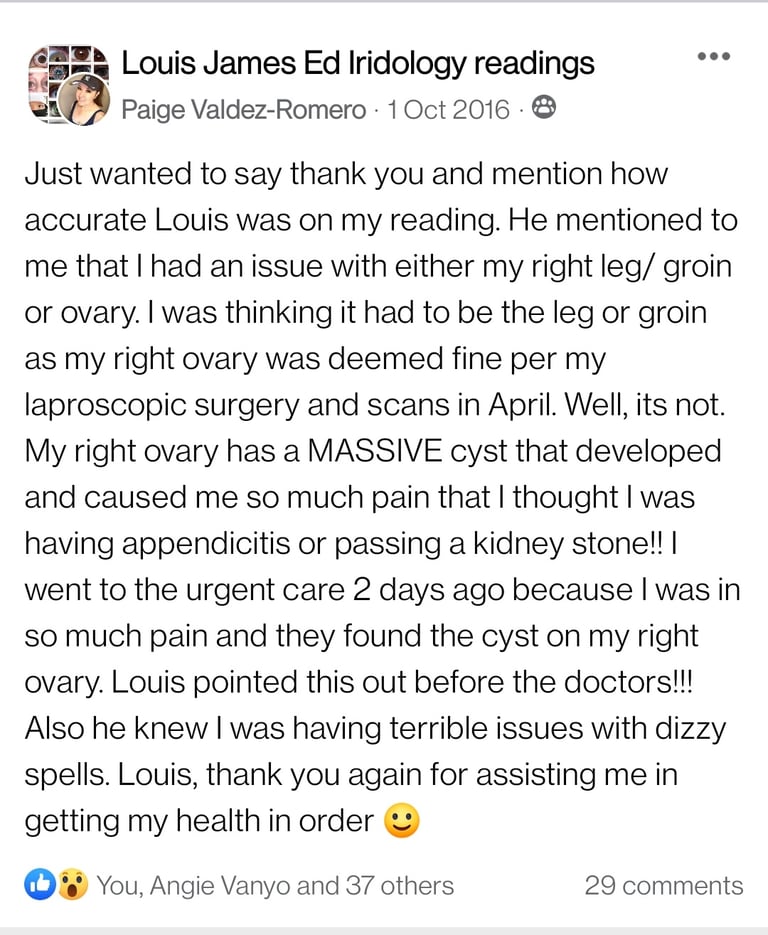
I read the message a few times when it came through. Every now and then in this work but not often, but enough to notice, something shows up in the iris that hasn’t been picked up elsewhere, and only later does the conventional system catch it. When that happens and a message like this arrives, it doesn’t feel like a win. It’s quiet. It carries a kind of weight, a reminder of what this work is really for.
It’s not about the moments where everything is vague and the iris only reflects general patterns. It’s about the moments when someone is in real pain, up in the middle of the night, scared, going to urgent care and there had already been a small piece of information pointing toward it, written down months earlier from a reading.
What I want you to take from this
I am not going to tell you that iridology prevented Paige's cyst. It did not. I am not going to tell you that if Paige had acted more aggressively on the reading, she could have avoided the pain. I do not know that. Cysts develop. Some resolve on their own. Medicine would have found it eventually; the pain alone would have ensured that.
What I will tell you is this: the iris showed a stress pattern in a specific zone before a cyst of significant size was confirmed in that zone by urgent care doctors. That is the account. I have not added to it and I have not taken from it.
What Paige’s story shows and what I’ve seen in different ways over fifteen years and hundreds of readings is that the body often signals before anything fully develops. There can be signs of strain before a clear diagnosis appears, patterns that show up before anything is formally identified.
Iridology, at its core, isn’t trying to answer "What disease is this?” Instead, it asks where the body might be under the most pressure and what that could mean going forward.
That’s a different kind of question than the one medicine usually asks. It’s not better, and it’s not a replacement. It just comes from another angle one that, sometimes, can be meaningful even when conventional tests haven’t yet given a clear answer.
Paige's right ovary, declared clear in April. Found to contain a massive cyst in October. Identified as a zone of concern between those two dates, by an iris reading.
That is the account. I will leave you to make of it what you will.
A note on what iridology is and is not
I include a section like this in every article that involves a clinical story, because it’s important to be clear. Iridology isn’t diagnostic. I can’t look at your iris and tell you that you have a cyst, a tumor, or a thyroid condition. No iridologist can and anyone who says they can is stepping beyond the honest limits of the practice.
What I can do is point to where the iris suggests the body may be under the most strain where it seems to be carrying a heavier load. And sometimes, as in Paige’s case, that level of detail can still be genuinely useful alongside clinical care.
-A quick note on this article: this is a factual account of a client’s experience. It isn’t medical advice, and it shouldn’t be used to self-diagnose or to delay seeking proper medical care.
Iridology is meant to complement, not replace, conventional medicine. If you’re dealing with pain or any health concerns, it’s important to speak with your doctor as a priority. Readings like these are there to sit alongside medical care, not take the place of it.
Get in touch
Write to Louis
directly.
Whether you have a question about iridology, want to know which supplement is right for you, or simply aren't sure where to start — Louis reads every message personally and responds within 48 hours.
Response time
Within 48 hours
Monday – Friday · 9am – 5pm GMT
"No question is too small. If you're uncertain whether iridology or natural health is right for your situation, just ask — I'd rather help you make the right decision than have you book when it's not the right fit."
— Louis James